
Vivek Radhakrishnan
“In tissue engineering, we are not just creating tissues—we are creating hope for patients who have run out of options.”
— Gordana Vunjak-Novakovic
“There isn’t anything more we can do.”
That’s a phrase no one wants to hear—especially when a loved one is in need of medical care. Whether it’s because treatment options don’t exist, or worse, they do but aren’t feasible or accessible, the helplessness that follows can be overwhelming.
Imagine facing a traumatic accident that requires amputation. Or being diagnosed with a localized cancer that can’t be surgically removed. Maybe you’ve lost a few adult teeth, or your organs are failing and you need an urgent transplant. In these moments, one question naturally arises:
“Can’t we just grow new organs in the lab and transplant them?”
Well, you’re not entirely wrong.
This dream—of growing functional tissues and organs in the lab—isn’t just science fiction anymore. It’s becoming increasingly possible. Not only for transplants, but also for healing severe burns, chronic wounds, and injuries that the body can no longer repair on its own.
Current Treatments—and Their Limitations
Today, treatment often involves procedures like:
- Autografts: taking tissue from another part of your own body and transplanting it to the damaged area. This creates a new wound site, known as a secondary defect.
- Allografts: using donor tissues, which can lead to immune rejection or disease transmission.
To avoid these issues, metal implants have been developed. While they’ve improved lives, they come with their own problems—like infection, rejection, mechanical failure, and the inability to mimic the dynamic nature of living tissues.
These limitations have pushed scientists and engineers to think differently—to harness biology and technology together in entirely new ways.
Enter Tissue Engineering
Tissue engineering is a field that emerged in the mid-1980s, born out of necessity and driven by innovation. It combines principles from cell biology, epigenetics, genetic engineering, materials science, biochemistry, and stem cell biology to create new, functional tissues that can replace or repair damaged ones.
The goal? To restore, maintain, or improve tissue and organ function—not just manage disease, but reverse it.
How Does It Work?
At its core, tissue engineering involves placing the right types of cells into a supportive structure, in an environment that helps the body heal or rebuild itself. These engineered constructs can be used for therapeutic applications—like skin grafts or organ regeneration—or even non-therapeutic uses, such as:
- Biosensors to detect harmful chemicals or pathogens
- Organ-on-chip platforms to model diseases or test drug toxicity
- Lab-grown meat to offer sustainable alternatives to traditional farming
What Does It Take to Engineer a Tissue?
To engineer a living, functional tissue, three key components are essential:
🧬 1. Cells
Cells are the basic functional units of life. Given the right signals, they can build or rebuild tissues. These can be sourced from:
- Primary cells (directly from the patient)
- Stem cells (which can differentiate into different tissue types)
- Induced pluripotent stem cells (iPSCs) – adult cells like those from fat tissue, reprogrammed to become other specialized cells
- Commercially available cell lines used in research and testing
🧱 2. Biomaterials and Scaffolds
Cells need a structure to grow in—the scaffold. These materials:
- Provide physical shape and support
- Can be infused with biological molecules to guide cell behavior
- Must be biocompatible, sometimes biodegradable, and able to mimic the 3D architecture of natural tissues
⚙️ 3. Biochemical and Biomechanical Cues
Cells don’t grow or function properly in isolation—they need the right signals:
- Growth factors to stimulate survival and differentiation
- Mechanical forces to replicate natural stress experienced in the body
- These cues are often delivered in a bioreactor—a controlled environment that mimics the in vivo conditions the tissue will face after implantation
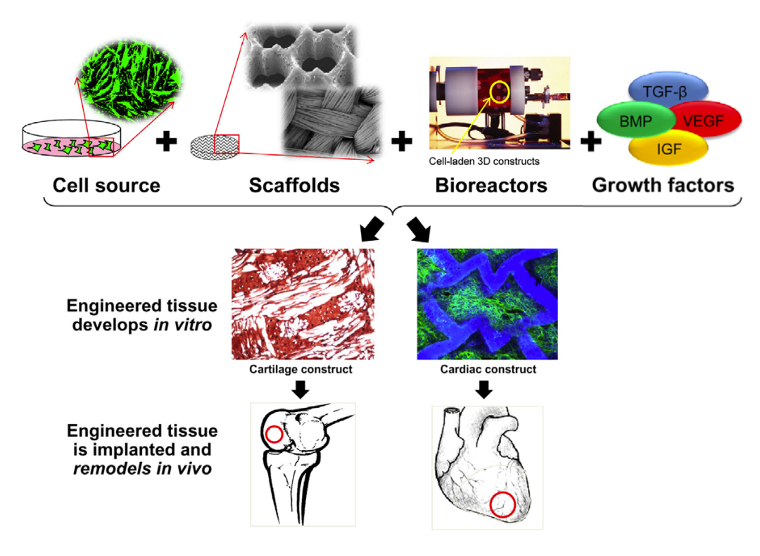
🧪 Fig: Strategy for engineering functional tissues in vitro—combining cells, scaffolds, bioreactors, and growth factors to create viable constructs for therapy [1].
The Road Forward
Tissue engineering is a rapidly evolving field with enormous potential to address unmet clinical needs. By blending biology with engineering, it offers real solutions to critical medical challenges and new hope—not just for patients needing transplants, but for anyone who dreams of a future where “there isn’t anything more we can do” becomes a phrase of the past.
From regenerating lost tissues to modeling diseases and testing new therapies, this field is more than just a scientific breakthrough—it’s a revolution in how we think about healing.
References:
Bara, Jennifer J., and Farshid Guilak. “Engineering functional tissues: in vitro culture parameters.” Principles of Tissue Engineering. Academic Press, 2020. 157-177.

 Engineering Life, One Cell at a Time
Leave a comment